

Ganga possesses healing properties
“Ganga possesses healing properties,”
“River Ganga” is considered the holiest river in India and the Hindus around the world pray this river. Even after death many people wants to cremate the dead bodies of their near ones on Ganga River front at Manikarnika Ghat(Hindi: मणिकर्णिका घाट), which is considered as one of the holiest cremation grounds among the sacred riverfronts (ghats), located on the banks of River Ganges, in the city of Varanasi in the Indian state of Uttar Pradesh.
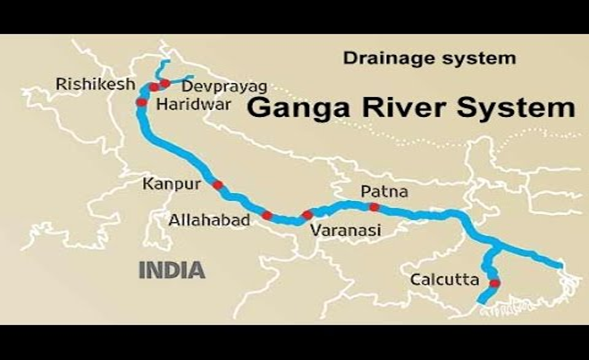
Course of River Ganges in India
There is a common saying that lots of “illness gets cured after taking a dip in Ganges River”. There are areas along the path of Ganga River which are very polluted.
Interestingly, important things to note that more than 660 million people took the bath in Ganga River, on Maha Kumbh which ended on Feb 26th, 2025, but there is no news of any outbreaks of any diseases like – Cholera/ diarrhea etc. or any hospitalization after “Ganga River Dip” The Holy dip is usually taken at “ Triveni” where 3 river meets – Ganga –Yamuna – Saraswati (the river which has dried up”).
“What is the reason that despite such a big gathering there is no news of any major outbreaks.”
• Hindus consider the waters of the Ganges to be both pure and purifying. Regardless of all scientific understanding of its waters,
• It is believed that taking a sacred bath in the Ganga River will purify the soul and wash away all the sins you might have committed, leading to Moksha, or spiritual enlightenment. Devotees believe that the river, with the heavenly element of purity, has descended from heaven.
• For more than a century, scientists documented the “self-cleansing and special healing properties” of Ganga water and identified bacteriophage as the reason behind the same. But why is the bacteriophage load so high in Ganga compared to other rivers?
• Study reveals that the Ganga River remains germ-free despite massive footfalls during Maha Kumbh. This is attributed to 1,100 types of bacteriophages in their water that eliminate harmful bacteria instantly.
• The water of river Ganga is of course having Bacteriophages, the viruses that eat bacteria, don’t allow bacterial growth were found in the waters of Ganga. (A bacteriophage is a virus that infects a bacterium and replicates within the bacterium and destroys it.)
• Bacteriophages have been used as an alternative to antibiotics against infectious diseases for over 90 years. Bacteriophages are composed of proteins that encapsulate DNA or RNA genome and may have structures that are either simple or elaborate. Bacteriophages copy inside the bacterium following the injection of their genome into its cytoplasm. Bacteriophages are one of the most common and diverse bodies in the biosphere. Bacteriophages are ubiquitous viruses, found wherever bacteria exist.
• Even after adding five times more E. coli to the water, it did not affect the natural biological structure of the water. Ganga water was found to destroy E. coli much more effectively than other waters, and even 16-year-old Ganga water was able to eliminate E. coli effectively. This was attributed to bacteriophages, which work similarly to bacteria-eating organisms on E. coli. (British bacteriologist Ernest Hankin in 1896,
• These studies claim that Ganga water has unique antibiotic properties, making it highly effective. Given its exceptional liquidity and antibiotic characteristics, it could provide a vital foundation for developing new antibiotics.
• “The Ganga’s self-purification capacity is due to its extraordinary ability to maintain high dissolved oxygen (DO) levels from its environment. This is why Ganga water is considered sacred. Scientists have studied that Ganga water remains pure when sourced from the river and does not become contaminated even after being stored for years. This medicinal quality is attributed to the herbs and minerals that mix into the water,”
• Another study cited in the judgment by the New Delhi-based Malaria Research Centre observed that mosquitoes did not breed in the upper reaches of the Ganga and, when mixed with other water sources, even prevented mosquito breeding.
• “Generally, organic matter in rivers depletes the oxygen available and decays slowly. But in the case of the Ganga, an unknown element affects these organic matters and bacteria, destroying them. Due to Ganga’s self-purification properties, its oxygen levels are 25 times higher than other rivers.”
This is why Ganga water is considered sacred.
Dr. Suresh Khanna


