Sarva Dharma Sambhava
Exploring the Intertwined Paths of Sikhi and Sanatan Dharam And Ram Janmabhoomi Movement
The concept of “Sarva Dharma Sambhava” signifies the harmony and equality of all truths or spiritual paths. While often interpreted as “all religions are the same,” a deeper understanding, particularly in the context of Indian philosophy, highlights the interconnectedness of spiritual traditions. This resonates with the ancient Sanskrit phrase “VasudhaivaKutumbakam” from the Maha Upanishad, meaning “The world is one family,” emphasizing unity and shared responsibility among all people.
The Essence of Sikhi and its Roots
The land of Punjab, historically known as “Panchanada” (Land of Five Rivers) in Sanskrit before the Mughal era, is the birthplace of Sikhi. The term “Sikh” originates from the Sanskrit word “Sisay,” meaning ‘seeker’ or ‘disciple.’ Guru Nanak Dev Ji, the founder, named the spiritual path “Sikhi,” defining a Sikh as “Any human being who faithfully believes in Sikhi Panth” (Chapter 1, Sikh Rehat Maryada). The term “Sikhism” was a European colonial designation from the 19th century, not found in the Siri Guru Granth Sahib Ji. “Sikhi” itself denotes not just a religion, but a continuous journey of learning, engagement, and a way of life, reflecting a dynamic pursuit of self-discovery.
Sikh Involvement in the Ram Janmabhoomi Movement
A lesser-known aspect of the Ram Janmabhoomi movement is the significant historical involvement of Sikhs. Guru Nanak Dev Ji himself visited the Ram Temple around 1510-1511 CE.
The first legal action for the Ram Janmabhoomi was reportedly filed by Baba Fakir Singh Khalsa, a Nihang Sikh, in 1858. Historical records, including a 2019 Supreme Court judgment, indicate that on November 28th, 1858, Baba Fakir Singh Ji, along with 25 Nihang Sikhs, entered the Babri Masjid, built a “Chabutra” (platform), installed an idol of Rama, and hoisted a saffron flag over the structure, even writing “Ram-Ram” on the walls. This event was also documented in an FIR filed on November 30, 1858, by Mohd Salim against the Nihang Sikhs for these actions.
Nihang Sikh sadhus also played a role in defending the Hanuman Garhi temple when it was attacked, subsequently entering the Babri Masjid. More recently, on January 22, 2024, Baba Harjit Singh Rasulpur, an eighth-generation descendant of Baba Fakir Singh Khalsa, organized a ‘langar Sewa’ at the Ayodhya Ram Temple to honor his ancestors. Additionally, the Sikh community organized a three-day ‘Akhand Path’ at Gurdwara Brahm Kund Sahib in Ayodhya from January 19-21, leading up to the ‘Pran Pratishtha’ (consecration) of the Ram Temple. This Gurudwara is believed to be the spot where Lord Brahma meditated for 5000 years.
Historical Connections to Ayodhya and Hindu Deities
Several Sikh Gurus, including Guru Nanak Dev, Guru Tegh Bahadur, and Guru Gobind Singh (as a child), visited Ayodhya at different times. Three Sikh shrines exist near Brahm Kund on the banks of the Saryu River. These shrines were initially maintained by Brahmin priests before being entrusted to Kashmiri Sikh Shri Gulab Singh in the mid-19th century, who built Gurudwara Guru Gobind Singh Ji in 1899.
Historically, many Gurdwaras, including the original Sri Hari Mandir Sahib (now known as the Golden Temple), housed idols, pictures, or paintings of Hindu deities such as Shiva, Vishnu, and various Devi Devtas, alongside those of Guru Nanak Ji, until the 1930s. The name “Harmandir Sahib” itself translates to “Temple of Vishnu,” with “Hari” being another name for Vishnu and “Mandir” meaning temple.
“Rama” (ਰਾਮ), also known as Ram Avtar (ਰਾਮਅਵਤਾਰ) or Raja Ram (ਰਾਜਾਰਾਮ), holds significance in Sikhi. He is included as one of the 24 incarnations of Vishnu in the Chaubis Avtar, a composition within the Dasam Granth. The word “Rama” appears over 2,500 times in the Guru Granth Sahib. “Ath Beesvan Ram Avtar Kathan,” a composition in the Dasam Granth attributed to Guru Gobind Singh Ji, further details the narrative of Rama.
Intriguingly, Mata Kaushalya, Lord Rama’s mother, is believed to have hailed from Gharram, a village in Punjab. According to local traditions and recent reports, Raja Dashrath’s wedding procession passed through Gharram, where he married Kaushalya, and Rama was born in his maternal grandfather’s palace there. The village reportedly celebrated the Ayodhya event on January 22nd with great fervor.
Both Guru Nanak Dev Ji (Bedi family) and Guru Gobind Singh Ji (Sodhi family) trace their lineage back to Luv and Kush, the sons of Lord Rama. This ancestral knowledge has been verbally passed down through generations within both families and confirmed by Sikh priests (Gyani) and parents. Guru Gobind Singh Ji’s Bachittar Natak, part of the Dasam Granth, mentions that Lava and Kusha established their kingdoms in Punjab, with Lahore originally named Lava Awar (fort of Lava) and Kasur built by Kusha.
“Mata Chandi Swaroop Was engraved on his Sword”
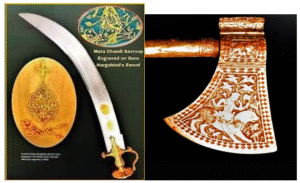
Guru Gobind Singh Ji’s reverence for Hindu deities is also evident. He is known to have worshipped the Hindu goddess Durga in her manifest form, and the image of “Mata Chandi Swaroop” was engraved on his sword. He also performed a Hom (fire ritual) at Naina Devi for six months, after which the Devi is said to have appeared and offered him a sword to fight for Dharma, leading to the formation of the Khalsa. There are records of Guru Gobind Singh and his father declaring Naina Devi as their Kuladevi (family deity). Furthermore, Guru Gobind Singh sent five of his most accomplished scholars to Kashi to study Sanskrit and Indian literary traditions; these scholars became known as Nirmalas. He also translated many chapters of the Devi Mahatmya from the Markandeya Purana and included them in his Dasam Granth, clearly acknowledging their source in compositions like Chandi di Var.
The British Influence and Engineered Separation
Historically, there was little distinction between Sikhs and Hindus. Many Hindu families traditionally had their first son initiated as a Sikh. Census records from the 1860s and even 1855 did not differentiate between Hindus and Sikhs, listing only Hindu and Muslim denominations.
The perceived separation between Sikhs and Hindus largely emerged after the British annexation of Punjab in the 1840s, following the end of Maharaja Ranjit Singh’s Empire. The British strategically encouraged division to consolidate their rule.
Maharaja Ranjit Singh, a Suryavanshi Rajput by ancestry, banned cow slaughter, patronized temples, and held Brahmins in high regard. He famously donated a ton of gold to plate the dome of the Kashi Vishwanath Temple at his wife Maharani Datar Kaur’s behest. During his rule (1799-1839), there was no practical distinction between Sikhs and Hindus. The Samadhi of Maharaja Ranjit Singh in Lahore stands as a testament to this shared heritage, with Hindu deities like Brahma, Shiva, and Ganesh etched on its entrance staircase.
The British actively fostered a sense of separateness. Lord Dalhousie, after annexing Punjab in 1855, disbanded Sikh soldiers from the army. John Lawrence, the Chief Commissioner of Punjab, instigated Sikh soldiers against those from Uttar Pradesh and Bihar, blaming them for the downfall of Ranjit Singh’s kingdom. The British praised Sikh valor and encouraged adherence to Sikh traditions, ostensibly to protect them from “idolatry,” thereby subtly portraying Sikhs as distinct from Hindus. This led to the official recognition of Sikhs as a separate entity, fostering the idea of a distinct “Sikh nation.”
This policy was propagated through various channels:
- Army Camps: Cultivating feelings of separateness among Sikh soldiers.
- Education and Administration: Implementing policies that highlighted distinct Sikh identity.
- Religious Institutions: Exercising influence through Gurudwara priests to sway public opinion. The British even allowed the formation of Sikh Sabhas, which often expressed loyalty to the Crown and served as recruitment platforms for the British Army. The Khalsa Diwan, established in Lahore and Amritsar, excluded Sahajdharis and supported British policies.
European scholars like Max Arthur McAuliffe, supported by the British, championed the idea of a separate Sikh identity. He criticized earlier scholars like Trumpp, asserting that:
- Sikhi did not originate from Hindu Dharma but evolved as an independent religion, with Hindus attempting to “devour” it.
- The core Sikh philosophy was chivalry and unwavering loyalty to the master.
- The Hindu religion was the biggest enemy of Sikhi, and its protection was only possible with British support, thus urging loyalty to the British.
- To further instill this feeling, the British recognized Punjabi as the official language in Punjab, under the guise of preserving the Sikh religion.
- They also exploited caste dynamics to deepen divisions, arguing that Khalsa Sikhs did not respect the Hindu pantheon or observe Hindu rites, and that Sikh Gurus never practiced Vedic philosophy or Brahmanical rituals.
The removal of idols from Hari Mandir in Amritsar by Sikh loyalists, reportedly under the influence of General Dyer (of Jallianwala Bagh massacre fame) in 1919, and the dismissal of Brahmins, marked a significant step in this religious alienation. In 1920, Sikhs formed the Gurudwara Prabhandak Committee (SGPC) to regain control of Gurudwaras from Mahants. Since 1925, the SGPC has been controlled by the Akalis, who, driven by political ambitions, began to call for the territorialization of Sikhs, passing the Anandpur Sahib Resolution in 1973. This resolution, by hinting at the supremacy of the Sikh community and a separate identity, indirectly sowed the seeds for the Khalistan movement.
Understanding the Intertwined Roots: Sanatan Dharma and Sikhi
Despite the British efforts to create divisions, many continue to emphasize the profound interconnectedness of Sanatan Dharma and Sikhi. Guru Nanak Dev Ji’s beliefs were deeply rooted in the Vedas, as evidenced by references in the Guru Granth Sahib, such as “Omkaar Ved Nirmayi” (God created Vedas). The Guru Granth Sahib elaborates on the glory of the Vedas, and those who studied them were called Vedis (Bedis), as mentioned in the Dasam Granth (Vichitra Natak Adhyaya 4).
The debate over whether Sikhi is part of Hinduism or a separate religion often becomes “meaningless” when considering the multi-faceted nature of “Hinduism” itself. Sikhi, in essence, presents the message of the Vedas in a simplified, accessible language for the common person. The Sikh Gurus are revered not only by Sikhs but by all nationalists for their selfless sacrifices during challenging historical periods, consolidating society, providing direction, and resisting foreign rule. They lit the lamp of Vedic wisdom, guiding society towards the fundamental tenets of Indian culture: rationalism, action, and compassion.
The article distinguishes between “McSikhs” (a small, aggressive, and vocal minority, often associated with SGPC-aligned Sikhs) and “Guru Sikhs” (those who adhere to the core teachings). It calls for strengthening “Guru Sikhs” and exposing “Angrezi Sikhi” to allow for freer expression of the traditional understanding.
Post-independence political parties, particularly the Congress, are criticized for exacerbating existing disaffections for their own political objectives. The article highlights that the Congress propped up Bhindranwale, who incited the Khalistan Movement and reportedly instigated violence against Hindus. Simultaneously, Pakistan’s ISI supported Khalistan advocates like Jagjit Singh Chauhan, who established the Khalistan National Council and raised the Khalistan flag abroad. The US, Canada, and UK are criticized for turning a blind eye to these secessionist movements.
Despite these divisions, prominent Sikh leaders like Baba Gurbaksh Singh consistently affirmed that Sikhs and Hindus were one, with Sikhs being a part of the Hindu nation. Even Master Tara Singh, who later called for Sikh territorialization, once stated, “Hindus and Sikhs are in no way different from each other; it is Hindu blood is flowing in my veins.”
In a notable demonstration of shared heritage, the Shiromani Akali Dal attended a rally organized by VHP/Shri Ashok Singhal and Jagadguru Rambhadracharya, openly supporting the construction of the Ram Temple. This reflects a persistent strain of unity that transcends political divisions.
Dr. Suresh Khanna


