Namaste
Derived from Sanskrit, Namaste (Namas + te) combines the word Namas with the enclitic form of the second-person dative pronoun, te. The word Namha transforms to Namas through sandhi before the sound te.
Namaste (namaste, Devanagari: नमस्ते), also known as namaskar or namaskaram, is a traditional Hindu non-contact gesture of respectful greeting and honor used at any time of day on the Indian subcontinent and among the Nepalese and Indian diaspora.
Typically, Namaste is accompanied by a slight bow with hands pressed together, palms touching, fingers pointing upwards, and thumbs close to the chest. The folded hands gesture in Namaste is known as Añjali Mudra, a posture also found in Indian classical dances like Bharatanatyam and in yoga practice.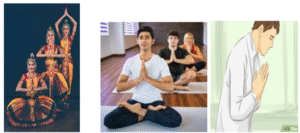
Namaskara mudra, Añjali mudra features thumbs that face the chest and are perpendicular to the fingers, whereas in Namaskara mudra, the thumbs align with the other fingers.
In Hinduism, Namaste carries a spiritual significance, reflecting the belief in the inherent divinity and oneness of the self (atman) in all beings. It conveys the meaning “I bow to the divine in you” or “the sacred in me recognizes the sacred in you.”
It is believed that Namaste facilitates a flow of positive energy, connecting heart centers and chakras during this respectful exchange.
Scholars note that in deity worship, Namaste serves the same purpose as when greeting a guest or anyone else, expressing politeness, courtesy, honor, and hospitality. This aligns with ancient Hindu scriptures like the Taittiriya Upanishad, which advocates Atithi Devo Bhava (treat the guest like a god). It is also used as a form of goodbye.
While Namaste is often used for individual greetings, Namaskar is more commonly employed when addressing multiple people, often carrying a similar sense of reverence.
Furthermore, Namaste can also be used to seek forgiveness and is considered a polite way to acknowledge wrongdoing.
As a non-contact greeting, Namaste offers the benefit of preventing the spread of infection.
Dr. Suresh Khanna


